What is the Affordable Care Act (ACA)?

The Affordable Care Act (ACA), officially the Patient Protection and Affordable Care Act is a comprehensive healthcare reform law signed into law in March 2010.
Its primary goals are to increase access to affordable health insurance, expand consumer protections, and reduce overall healthcare spending across the United States.
Core Pillars of the Law
Expanding Access to Insurance:
Insurance Marketplaces & Subsidies: Created state and federal exchange platforms where individuals and small businesses can buy standardized plans with income-based tax credits (APTCs) and Cost-Sharing Reductions (CSRs).
Medicaid Expansion: Allowed states to expand Medicaid eligibility to adults with household incomes up to 138% of the federal poverty level (FPL).
Dependent Coverage to Age 26: Permits young adults to stay on a parent’s health plan until turning 26.
Key Consumer Protections:
Guaranteed Issue & Pre-Existing Conditions: Insurers cannot deny coverage or charge higher premiums based on health history, gender, or pre-existing medical conditions.
10 Essential Health Benefits: Mandates that individual and small-group plans cover core services such as emergency care, prescription drugs, mental health, and maternity care.
Preventive Services at No Cost: Eliminates copays and deductibles for recommended preventive screenings, vaccines, and wellness visits.
Ban on Lifetime & Annual Dollar Limits: Prohibits insurers from placing caps on the total dollar amount spent on essential health benefits over a lifetime or within a single year.
The ACA Marketplace (also called the Health Insurance Exchange) is a service established under the Affordable Care Act where individuals, families, and small businesses can compare, shop for, and enroll in standardized, private health insurance plans.
Depending on the state, the Marketplace is operated either directly by the federal government through HealthCare.gov or through a state-run platform (such as Covered California, NY State of Health, or Pennie).
Core Functions & Protections
Income-Based Financial Assistance: The Marketplace is the exclusive platform where eligible consumers can access federal subsidies, including Advance Premium Tax Credits (APTC) to lower monthly premiums and Cost-Sharing Reductions (CSR) to decrease out-of-pocket expenses.
Essential Health Benefits: Every Qualified Health Plan (QHP) must cover 10 core categories of care, including outpatient care, emergency services, hospitalization, maternity/newborn care, mental health services, prescription drugs, and preventive screenings at no cost.
Pre-Existing Condition Protection: Insurers cannot deny coverage, drop policyholders, or charge higher premiums based on health status or medical history.
Medicaid & CHIP Screening: Applications automatically determine whether an individual or household qualifies for low-cost or free coverage through Medicaid or the Children’s Health Insurance Program.
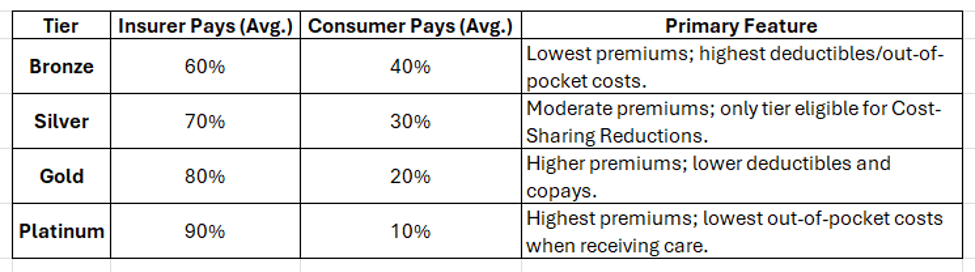
Plan Categories (Metal Tiers)
Plans are categorized into standardized tiers based on how you and the insurer split medical costs (excluding monthly premiums):
Who Uses the Marketplace & When to Enroll
The Marketplace primarily serves self-employed individuals, gig workers, early retirees, and employees whose jobs do not provide affordable, qualifying health coverage.
Open Enrollment Period (OEP): The standard annual window to enroll or switch plans, typically running from November 1 to January 15 in most states.
Special Enrollment Period (SEP): Enrollment outside the standard window is allowed within 60 days of a Qualifying Life Event (QLE), such as job loss, marriage, divorce, relocation, or the birth/adoption of a child.
Get more information or a free consultation through my website.

Comments